12mm Tube × R3/8 BSPT Pneumatic Cylinder Meter-Out Speed Control
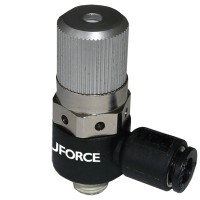
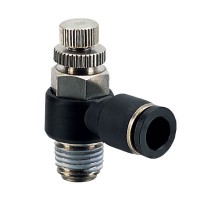
The Pneuforce JSC12-03 is a nickel-plated brass, right-angle pneumatic speed controller with a 12mm push-to-connect tube port and a R3/8 BSPT male cylinder-port connection. It is designed to mount at a cylinder port and adjust movement by regulating exhaust air rather than throttling the incoming compressed-air supply.
Air entering from the tube connection flows freely to the threaded cylinder connection through the check-valve bypass. Air exhausting from the cylinder travels from the threaded port toward the tube connection through the adjustable needle restriction. This meter-out arrangement is commonly used to set the extension and retraction speeds of double-acting pneumatic cylinders. Supply air flows without needle restriction from the tubing connection into the cylinder port. The adjustable needle restricts exhaust airflow leaving the cylinder, allowing the cylinder speed to be set.
Technical Specifications
| Specification | Details |
|---|---|
| Product Type | Right-angle unidirectional pneumatic speed controller |
| Part Number | JSC12-03 |
| Tube Size | 12mm |
| Thread / Port Size | R3/8 BSPT |
| Control Configuration | Meter-out; adjustable cylinder exhaust, unrestricted reverse supply |
| Flow Control | Tube → thread: free-flow supply; thread → tube: metered exhaust |
| Tube Connection | Push-to-connect |
| Body Material | Nickel-plated brass |
| Service | Industrial compressed air systems |
| HS / HTS Code | HS Code 3917.40 & HTS Code 3917.40.0095 |
| Typical Installation | Male thread at the pneumatic cylinder port; push-to-connect tube toward directional valve |
| Double-Acting Cylinder | Normally one meter-out controller at each cylinder port for independent speed setting |
Meter-Out Cylinder Speed Control
For a conventional double-acting cylinder, fit one JSC at the cap-end port and another at the rod-end port. During extension, the rod-end chamber exhausts through its adjusted controller; during retraction, the cap-end chamber exhausts through the other. The incoming air is unrestricted at each controller. This lets the two stroke directions be adjusted separately, while the metered exhaust provides useful back-pressure control under changing loads.
Key Features
- 12mm push-to-connect pneumatic tube connection with R3/8 BSPT male cylinder-port thread
- One-way needle valve meters air from the threaded cylinder port to the tube
- Built-in check valve bypasses the needle restriction when compressed air enters the cylinder
- Mounts directly at cylinder port for local extension or retraction speed adjustment
- Two controllers can regulate both stroke directions of a double-acting cylinder independently
- Compact right-angle nickel-plated brass body for industrial pneumatic assemblies
Typical Applications
- Double-acting pneumatic cylinder extension and retraction speed control
- Packaging and cartoning equipment with adjustable cylinder strokes
- Assembly fixtures, clamp cylinders and part-positioning mechanisms
- Pick-and-place machinery with controlled pneumatic actuators
- Pneumatic slides, gates and indexing stations
- Machine retrofits requiring adjustment at individual cylinder ports
How the JSC Works
The JSC contains an adjustable needle and a parallel check-valve bypass. With the male thread installed at the cylinder, supply air from the tube enters the cylinder freely. When the cylinder chamber exhausts, air flows out from thread to tube through the needle, allowing the operator to tune cylinder speed. On a conventional double-acting cylinder, the rod-end controller meters extension exhaust and the cap-end controller meters retraction exhaust.
Frequently Asked Questions
Which airflow direction does this JSC restrict?+
This JSC12-03 is factory-configured for meter-out service when fitted at the cylinder port: supply air flows freely from the 12mm tube connection to the R3/8 BSPT male threaded port. Air leaving the cylinder is adjustable from thread to tube.
Do I need one flow control on each port of a double-acting pneumatic cylinder?+
Typically yes. Install one meter-out speed controller at each cylinder port to adjust extension and retraction independently. Each controller meters air exhausting from its own chamber, not the air entering that chamber.
Which control sets extension speed and which sets retraction speed?+
On a conventional double-acting cylinder, the rod-end chamber exhausts during extension, so the rod-end control sets extension speed. The cap-end chamber exhausts during retraction, so the cap-end control sets retraction speed.
Why control the exhaust air instead of restricting supply air?+
Meter-out adjustment maintains some opposing chamber pressure as the piston moves. This often provides smoother, steadier motion and helps limit speed changes with varying load compared with meter-in control.
What tube and cylinder-port connections does this model use?+
JSC12-03 connects 12mm pneumatic tubing to a R3/8 BSPT male threaded cylinder port. Select tubing by its outside diameter and verify the cylinder port thread and sealing method.
Is this the same as a two-way needle valve?+
No. The JSC has a check-valve bypass for unrestricted supply in one direction; the needle adjusts exhaust in the opposite direction. A plain needle valve restricts both directions.
What does the R thread designation mean?+
The R3/8 BSPT designation identifies a tapered BSPT male connection. Use a correctly matched female port and an appropriate threaded sealing method; do not confuse an R (BSPT) thread with a G (BSPP) parallel thread.
How should cylinder speed be set during commissioning?+
Start with a conservative exhaust setting, operate the machine at safe test conditions, and adjust the needle in small increments. Confirm both stroke speeds and end-of-stroke cushioning. Do not use a speed controller as a safety lock.
Ships from Indianapolis, USA
- Stock: 75
