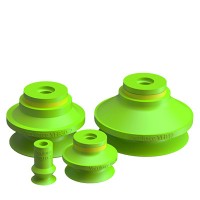
80mm NBR Traction Steel Stamping Cup STC80N-60-3/8NPSF
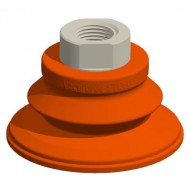
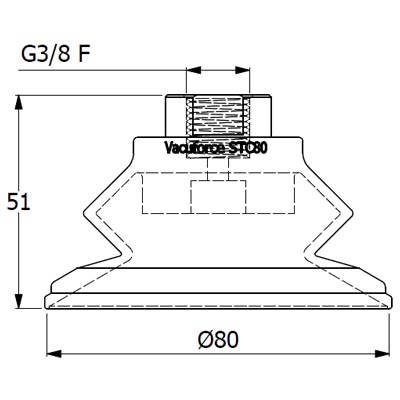
Vacuforce STC80N-60-3/8NPSF is a 80mm heavy-duty NBR traction cup specified at 60 Shore A, for vacuum gripping in steel stamping and press-line automation.
The traction-style single-bellows profile provides limited compliance on formed panels and moderate height variation. With 3/8 NPSF female, this variant is suited for appropriate press-transfer tooling. Validate sealing and sideways loads where drawing oils are present.
Technical Specifications
| HTS Code | 4016.99.6050 |
| Model | STC80N-60-3/8NPSF |
| Cup Style | traction / single-bellows |
| Nominal Cup Size | 80mm |
| Cup Material | nitrile rubber (NBR) |
| Vacuum / Mounting Connection | 3/8 NPSF female |
| Main Application | Steel stamping and pressed sheet-metal handling |
| Material Hardness | 60 Shore A |
Selection & Application Guidance
The traction-style single-bellows profile provides limited compliance on formed panels and moderate height variation. With 3/8 NPSF female, this variant is suited for appropriate press-transfer tooling. Validate sealing and sideways loads where drawing oils are present. The lifting-force figures shown are theoretical; choose the working load using the correct design factor and production trials.
Product Features & Existing Technical Details
- Automotive steel stamping
- Temperature Range -40C to +120C / -40F to +248F
- Glass handling
- Plywood transfer
- Handling of oily steel surfaces
- Concave and convex surfaces
- Large box & carton handling
Typical Applications
- Steel press and transfer-press automation
- Automotive stamping and formed panels
- Oily or contoured sheet-metal pickup
- Automated sheet handling with compliant end-of-arm tooling
Important: Product suitability depends on the actual operating conditions. Confirm dimensions, connections, material compatibility, vacuum or pressure requirements, cycle conditions and any required safety factor before final machine integration.
Estimated Lifting Force at 24"Hg
Theoretical lifting force is calculated from the cup's nominal sealing area at approximately 80% vacuum. At sea level, 80% vacuum corresponds to approximately 11.76 PSI differential pressure.
Lifting Force Calculation
| Calculation Step | Metric | Imperial |
|---|---|---|
| Nominal Area | π × (4cm radius)² = 50.3cm² | π × (1.575in radius)² = 7.79in² |
| Vacuum Level | 80% vacuum | 24"Hg / 11.76 PSI differential |
| Estimated Theoretical Lift | 50.3 × 0.8 = 40.2kg | 7.79 × 11.76 = 91.6lb |
Important: Lifting force is theoretical and must not be used as the final working load without an appropriate engineering safety factor. Actual holding force depends on vacuum level, surface condition, porosity, cup orientation, acceleration, leakage and dynamic loading.
Frequently Asked Questions
Where is the 80mm STC traction cup used?+
This heavy-duty traction-style NBR cup is intended for handling press-formed sheet metal, oily steel blanks and industrial panels where a durable sealing lip and reliable contact are required.
How does STC differ from a flat SFF cup?+
STC uses a traction / bellows-style profile to accommodate some height and surface variation; SFF is a flatter style often chosen for fast lateral transfers. Select by the actual panel shape, acceleration and available landing area.
What material and hardness are specified for STC80N-60-3/8NPSF?+
The model identifies nitrile rubber (NBR) at 60 Shore A. Check performance against drawing oils, temperature, contact pressure and any surface-marking restrictions.
Which mounting connection does this STC model use?+
The listed connection is 3/8 NPSF female. Confirm the port, fitting seal and mounting-envelope dimensions before installation.
Can this cup grip a contoured stamping?+
The traction / single-bellows profile can help with modest contour and height differences. Test at the intended vacuum level on the worst-case formed panel, including oil and surface contamination.
How should gripping capacity be established?+
The published lifting values are theoretical axial estimates at a stated vacuum level, not a rated safe working load. Account for acceleration, friction, leakage, surface condition and orientation; confirm the cup layout through application trials.
What matters most for automotive press-line uptime?+
Monitor lip wear, cycle count, forming-oil build-up, vacuum response, hose routing and release timing; ensure replacement cups match the model and mounting interface.
Ships from Indianapolis, USA
- Stock: Please Call