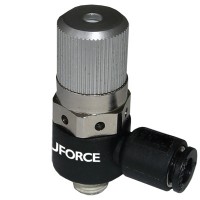
Rotary Pneumatic Valves for Manual Compressed Air Control
Rotary pneumatic valves provide simple and reliable manual control of compressed air systems using a rotary selector knob or handle. These manually actuated valves allow operators to start, stop, divert or select airflow paths within pneumatic circuits and are commonly used throughout industrial automation, machine building, workholding systems and compressed air distribution applications.
Unlike push-pull valves or hand lever valves, rotary valves use a turning motion to change valve position. This design provides clear visual indication of valve position while offering smooth and reliable operation in demanding industrial environments.
Download Rotary Valve Datasheet
What Is a Rotary Pneumatic Valve?
A rotary pneumatic valve is a manually operated directional control valve that changes airflow paths when the operator rotates a handle, selector switch or knob. Rotary valves are commonly used where multiple valve positions are required and where operators benefit from clear visual indication of the selected airflow path.
These valves are often used as selector valves, air isolation valves and manual control valves for pneumatic actuators and compressed air equipment.
Common Applications for Rotary Valves
Air Chucks and Workholding Equipment
Rotary valves are frequently used to control pneumatic chucks, clamps and workholding devices where operators need reliable and repeatable manual control.
Vacuum Venturi Systems
Many vacuum handling applications use rotary valves to activate and isolate vacuum venturi generators and vacuum circuits.
Pneumatic Cylinders and Actuators
Rotary valves are often used to manually extend and retract pneumatic cylinders during machine setup, maintenance and production operations.
Machine Guarding and Air Isolation
Rotary selector valves are commonly used to isolate compressed air systems during maintenance procedures and machine servicing operations.
Benefits of Rotary Pneumatic Valves
- Simple rotary operation
- Positive valve position indication
- No electrical power required
- Reliable mechanical operation
- Long service life
- Compact installation
- Suitable for industrial environments
- Available in multiple valve configurations
Rotary Valves vs Hand Lever Valves
Both rotary valves and hand lever valves provide manual pneumatic control. Rotary valves use a turning motion and often provide multiple selectable positions, while hand lever valves use a lever mechanism that typically shifts between two operating states.
Rotary valves are often preferred when airflow needs to be directed between multiple circuits or where valve position indication is important.
Typical Industries and Applications
- Industrial automation
- Manufacturing plants
- Machine building
- Packaging machinery
- Assembly systems
- Material handling equipment
- Automotive production
- Workholding fixtures
- Vacuum handling systems
- Compressed air distribution systems
Why Choose a Rotary Valve?
Rotary valves offer reliable manual control, clear operating positions and simple installation. They are ideal for operators who require direct control of airflow without electrical controls, PLC systems or pneumatic pilot signals.
Frequently Asked Questions
What is a rotary pneumatic valve?
A rotary pneumatic valve is a manually operated compressed air valve that uses a rotating handle or selector knob to control airflow direction.
What are rotary valves used for?
Rotary valves are used for air isolation, pneumatic cylinder control, vacuum systems, workholding devices and compressed air circuit selection.
How does a rotary pneumatic valve work?
Rotating the valve handle changes the internal airflow path, allowing compressed air to be directed to different ports or circuits.
Can rotary valves control pneumatic cylinders?
Yes. Rotary valves are commonly used to manually operate both single acting and double acting pneumatic cylinders.
Can rotary valves be used with vacuum systems?
Yes. Many rotary valves are suitable for controlling vacuum venturi generators and vacuum handling applications.
Do rotary valves require electricity?
No. Rotary valves are manually actuated and do not require electrical power or pneumatic pilot signals.
What is the advantage of a rotary valve over a hand lever valve?
Rotary valves often provide clearer position indication and can offer multiple operating positions for selecting between airflow circuits.
Are rotary valves suitable for machine isolation?
Yes. Rotary valves are commonly used to isolate compressed air systems during maintenance and servicing procedures.
What industries use rotary pneumatic valves?
Rotary valves are widely used in manufacturing, automation, packaging, machine building, material handling and maintenance applications.
How do I choose the correct rotary valve?
Selection depends on valve function, number of ports, flow requirements, operating pressure and the pneumatic equipment being controlled.